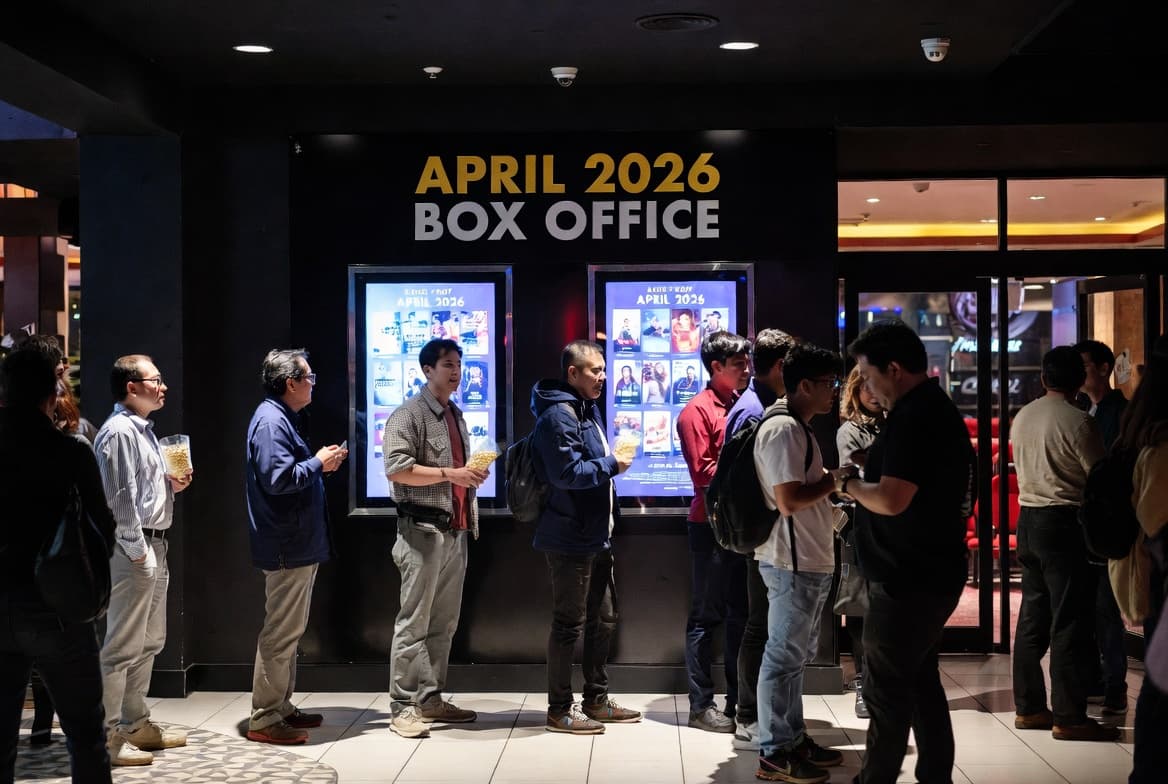
What the April 2026 box office is telling us about how audiences watch now
Midweek holds, premium-format share, and the failure of two franchise extensions point to an audience that treats the theater as an event and streaming as the default.
Elias Thorne
Loading... · 6 min read
The numbers that do not fit the old model
April 2026 has produced a box-office picture that is forcing analysts to revise their assumptions about the shape of the theatrical market. The month's top performers are not the widest releases. Midweek holds for originals are running 20–30% stronger than forecasts. And two $150-million-tier franchise extensions have opened below their immediate predecessors, despite larger marketing spends.
Premium-format share tells the clearest story. IMAX and Dolby screens, which represent roughly 3% of total screen count domestically, generated close to 18% of April's first two weekends of gross. That ratio has grown every quarter since late 2024, and it is no longer explicable as a post-pandemic novelty.
What it means about the audience
The clearest inference is that audiences have stopped treating theatrical and streaming as substitutes. Theatrical has become an event context — a conscious choice that has to be earned by the film's specific craft argument. Streaming is now the default, the thing viewers do by reflex. Middle-ground theatrical releases, the ones that offer neither event scale nor distinctive craft, are being squeezed out of the habit.
This is why the failure of the two franchise extensions matters more than the headlines suggest. Their opening weekends were not catastrophic; they were mediocre in a way that would have been acceptable in 2019. The 2026 audience is no longer paying for mediocre. It is paying for either spectacle or specificity, and the category in between is quietly dying in real time.
Which studios adapted in time
Warner Bros. and A24 entered April with release calendars that look, in retrospect, unusually well-calibrated to this audience. Both had titles positioned as either event releases or distinctive originals, with no middle-ground franchise entries cannibalizing their windows. Their month-end numbers reflect that discipline.
Universal and Sony were more mixed. Both had one calibrated release and one middle-ground entry. The middle-ground titles underperformed. That divergence inside a single studio's monthly slate is the cleanest recent demonstration that the audience is not rejecting studios — it is rejecting specific categorical bets.
Disney's April was the most closely watched of the month. Its two releases split along the same event-versus-default line: one positioned clearly as a premium-format event performed ahead of forecast, while a second title marketed as a reliable family offering underperformed its pre-release tracking by roughly 18%. Internal memos circulating among exhibitors suggest Disney is now formally retiring the 'reliable family offering' category from its 2027 calendar in favor of a smaller number of more sharply positioned releases.
The regional variance that complicates the story
The month-level numbers hide a sharp regional pattern. Large urban markets — New York, Los Angeles, Chicago, Toronto — are driving the premium-format share upward in ways that suburban and exurban markets simply are not. In several suburban circuits, traditional ticket pricing still dominates, and the audience's premium-format conversion rate is closer to 2024 levels than to the citywide 2026 averages.
That variance matters for release strategy. A film that performs well in premium formats in the top twenty markets can still underperform at the national level if its suburban opening does not hold. Two April titles show exactly this split, and the distribution teams behind them are privately reassessing how much of their media spend should be concentrated in urban premium-format promotion versus broader regional coverage. Exhibitors, for their part, are pushing studios to co-invest in premium-format upgrades outside the top markets, arguing that the format's growth depends on supply as much as demand.
Implications for summer 2026
The summer slate contains at least four releases that look, from the outside, like middle-ground bets. If April's patterns hold through May and into June, expect aggressive repositioning of two of those titles — likely toward earlier release dates or toward premium-format-first marketing — in an attempt to clarify which side of the audience's event-versus-default split they are trying to occupy.
The studios that read April correctly will enter the fall with sharper slates. The ones that wait for summer returns before adjusting will arrive at 2027 planning already behind.
Most viewed today
News · 7 min
The mid-budget theatrical film is quietly winning 2026
News · 6 min
What the April 2026 box office is telling us about how audiences watch now
News · 8 min
Inside the Denis Villeneuve playbook every studio is now trying to copy
News · 7 min
The character-actor renaissance is rewriting how A-list casting works
Article Personnel