
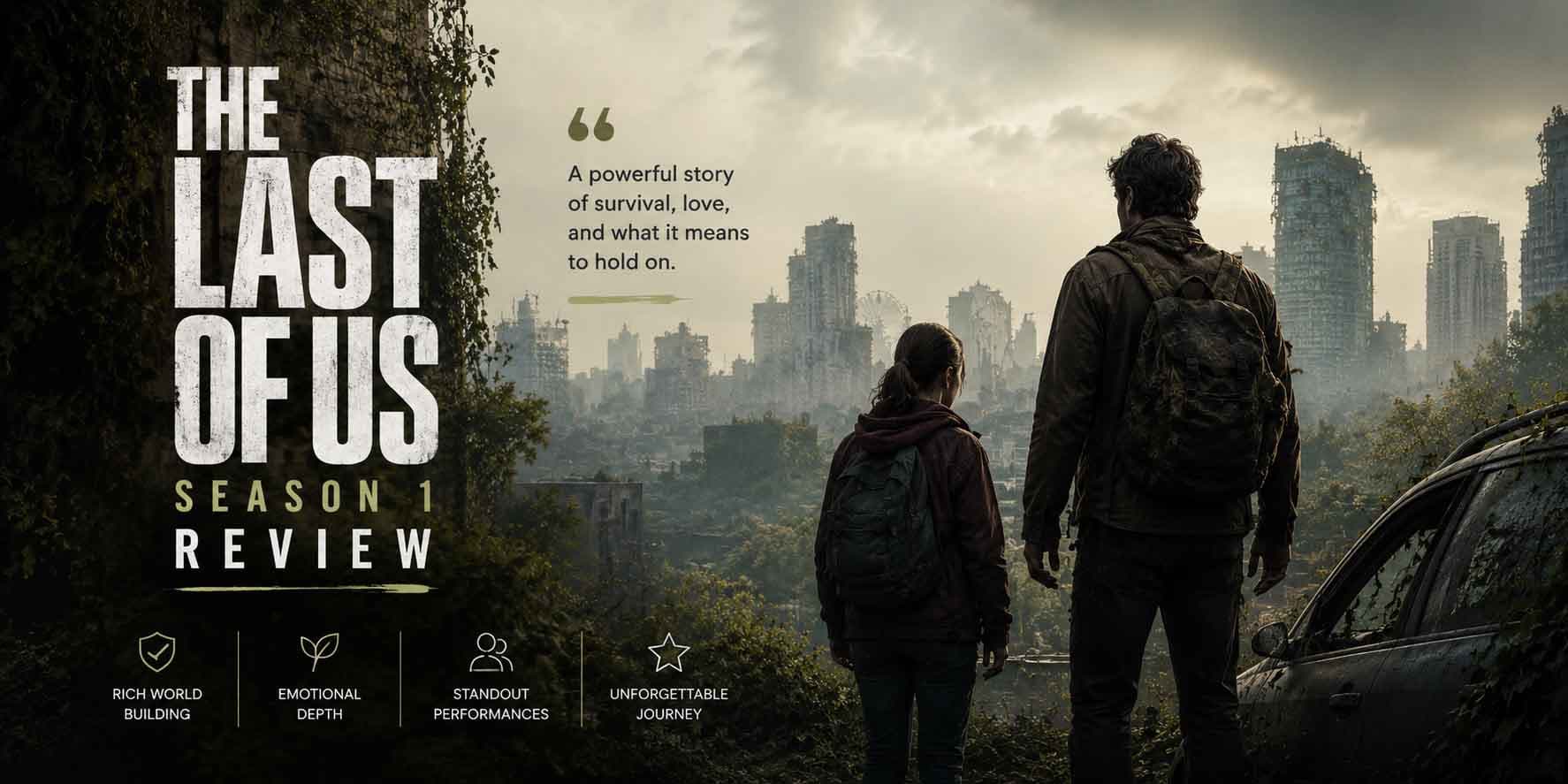

The Last of Us: Season 1 Review & Analysis
HBO's adaptation understands that the game's genius was never the zombies — and the result is the first prestige video-game series to actually deserve the label.
Craig Mazin, Neil Druckmann
Jan 14, 2023
Quick Verdict
“The first great video-game TV adaptation. Episode three is an all-time hour of television, and Pedro Pascal and Bella Ramsey build a father-daughter dynamic the genre has rarely earned.”
Plot Summary
Twenty years after a fungal pandemic collapsed civilization, smuggler Joel is hired to escort fourteen-year-old Ellie across a fractured United States. Ellie is immune. Their journey from the Boston QZ to a research lab in Salt Lake City takes them through a Kansas City insurgency, a post-apocalyptic Jackson settlement, and a private week in the woods that quietly reframes the whole trip.
Full Breakdown
An adaptation that trusts the game's emotional engineering
Craig Mazin and Neil Druckmann's key insight is that The Last of Us is a character piece with a zombie chassis, not the other way around. The show reproportions accordingly. Infected are a periodic threat; the real drama is the slow accumulation of moral debt between a traumatized adult and a teenager who refuses to be a symbol.
The adaptation also knows when to open up. 'Long, Long Time' — the standalone third episode — diverges from the game to tell a self-contained love story that becomes the season's thematic thesis. It is the boldest structural decision of any 2023 TV adaptation, and it works.
Pedro Pascal and Bella Ramsey do the heavy lifting together
Pedro Pascal's Joel is not a badass. Pascal plays him as a man who has been holding his grief in the same position for two decades and whose muscles have quietly atrophied around it. When Joel finally acts in the finale, Pascal has earned every prior quiet hour.
Bella Ramsey rejected the impulse to impersonate the game's Ellie and built a new one — sharper-tongued, physically smaller, emotionally more exposed. The back half of the season is largely carried by Ramsey, and the giraffe scene in episode nine lands because of the work Ramsey has done across the preceding seven hours.
Production design, sound, and the opening episode's pandemic sequence
The post-collapse Boston QZ, the Kansas City tunnels, and the Jackson settlement are the best-designed post-apocalyptic environments on serialized TV. The choice to build physically whenever possible gives the series a weight most contemporaries fake with blue screen.
Gustavo Santaolalla's game score is preserved and expanded, and the show's use of licensed songs — Linda Ronstadt's 'Long, Long Time,' Depeche Mode's 'Never Let Me Down Again' — is among the most disciplined on TV.
Pros and cons
Pros: Episode three is an instant all-time hour; Pascal and Ramsey's pairing is the anchor of the decade; production design at feature-film scale.
Cons: Infected-action fans will find the horror downplayed relative to the game; the middle stretch in Kansas City is the season's weakest arc; the finale's moral ambiguity will divide viewers who wanted a cleaner resolution.
What Hits
- Exceptional execution of drama, post-apocalyptic tropes
- Stunning cinematography and production design that demands a large screen
- A compelling lead performance that anchors the entire narrative
Pressure Points
- A few minor subplots feel slightly underdeveloped
- May feel overly familiar to long-time fans of the genre
95
Primary Cast
Featured Actors
Production Specs
Technical Details
You might also like
Similar titles worth reading

Join the discussion
Most viewed today

Features · 6 min
The Brutalist Is a Three-and-a-Half-Hour Dare — And It Earns Every Single Minute
News · 7 min
The mid-budget theatrical film is quietly winning 2026

News · 3 min
Christopher Nolan Taps Matt Damon and Zendaya for His Most Secretive Project Yet
News · 6 min